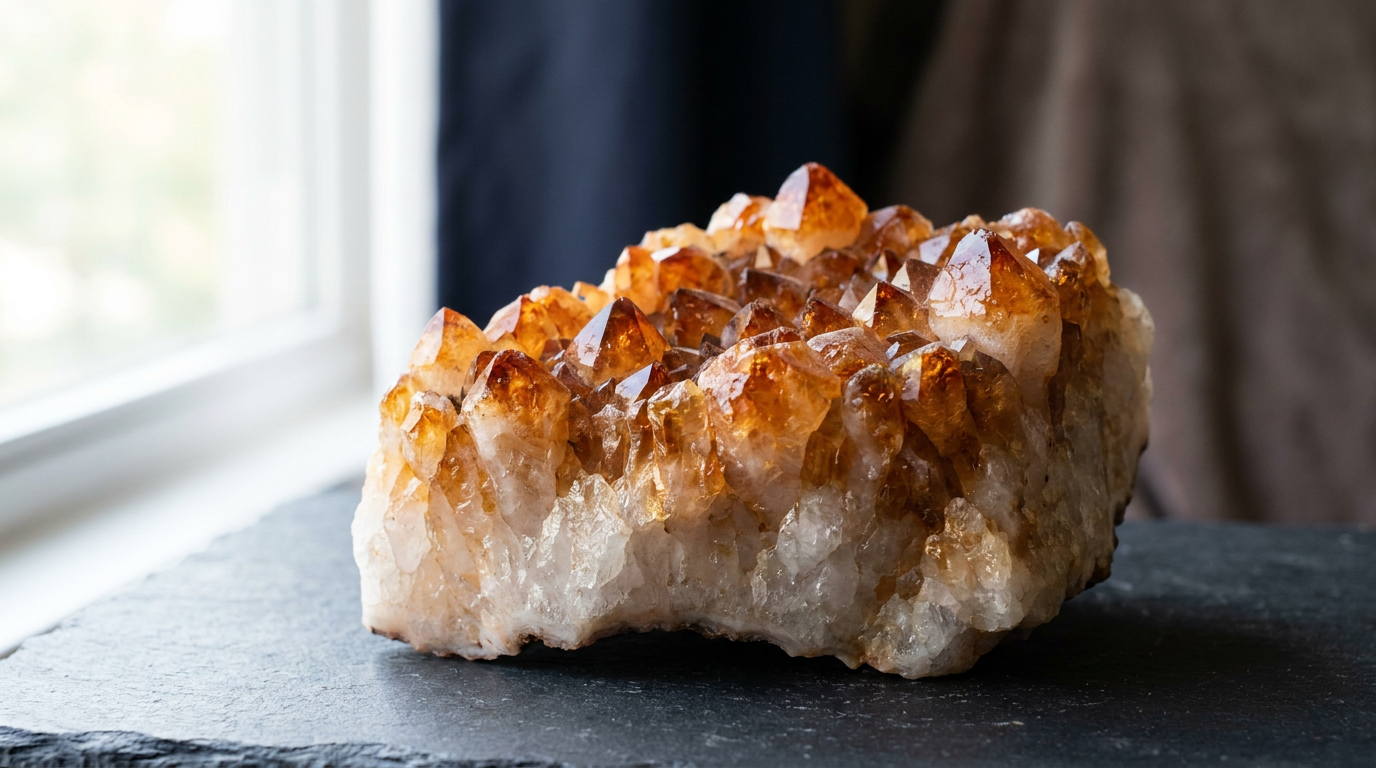
All it takes is one photograph of a bright orange citrine cluster for someone in the crystal community to declare, “That's not real citrine. It's just burnt amethyst.”
And more often than not, they're right.
At least about the amethyst.
What interests me is how quickly that factual observation becomes a judgment of worth. Suddenly, the crystal is considered fake, undesirable, or energetically inferior. Some collectors won't touch it, and certain crystal healers refuse to work with it altogether.
I understand the distinction they're making. I even agree with part of it. But I've never been entirely comfortable with the idea that heat-treated amethyst is somehow worthless simply because human hands participated in its transformation.
In fact, I see something rather beautiful in that process.
I see alchemy.
First, Let's Talk About What It Actually Is
Natural citrine is relatively uncommon. According to the Gemological Institute of America (GIA), most citrine available on the market is produced by heating amethyst, transforming its original purple coloration into shades ranging from golden yellow to deep reddish orange. Sometimes, the result is an almost fiery orange crystal with a pale or milky white base. Other specimens develop darker amber or burnt-orange hues.
Natural citrine can have a softer, more evenly distributed yellow or smoky-golden appearance, although both natural and treated material occur in a range of colors. Appearance alone isn't always enough to reliably distinguish them. The Gemmological Association of Great Britain (Gem-A) makes another important distinction: under stricter gemological terminology, heat-treated amethyst is not the same as naturally colored citrine, even though both are commonly sold under the name citrine.
So yes, there is a legitimate difference. And if someone is purchasing natural citrine, particularly at a premium price, they deserve to receive exactly that.
Where I begin to disagree with the purists is when treated becomes synonymous with fake. Because those aren't necessarily the same thing.
What Actually Happens When Amethyst Is Heated?
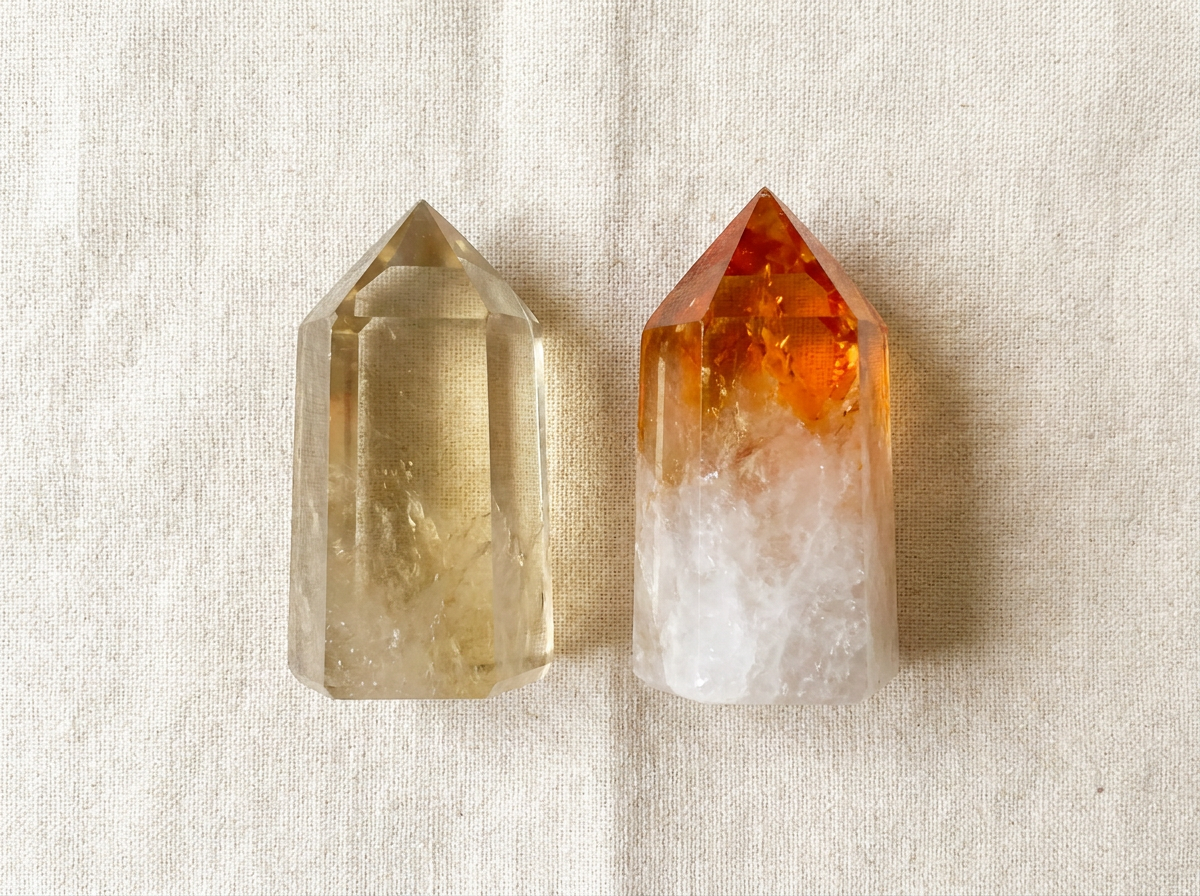
Here's something I find fascinating about the relationship between these two crystals. Amethyst and citrine belong to the same mineral family: quartz. Their fundamental chemical composition is silicon dioxide (SiO₂).
What gives them their distinctive appearances involves remarkably subtle differences within their crystal structures. Trace impurities, particularly iron-related features, influence the way quartz absorbs light. Natural radiation and temperature can alter these features, producing different colors.
When certain varieties of amethyst are exposed to sufficient heat, the structures responsible for their purple coloration change. Depending on the specimen and its original chemistry, the result can be yellow, orange, or brownish quartz. A 2020 study published in Scientific Reports examined these changes and documented how heating alters iron-related color centers in amethyst. The underlying mineral remains quartz, but something within it has changed.
And this is where I begin to find the process particularly interesting. The crystal hasn't simply been painted a different color. It has undergone a physical transformation.
Even more interestingly, nature isn't entirely removed from this process. Geological heating can also change the color of quartz under certain conditions. Of course, a crystal transformed by geological processes is not identical in history to one heated in a commercial oven. The distinction matters.
But it raises a question I think is worth exploring:
If transformation can occur within the earth itself, why do we automatically dismiss a transformation simply because humans initiated it?
Where I See Alchemy
Alchemy is often associated with the ancient pursuit of transforming lead into gold. But beyond that literal ambition, alchemy has a much richer philosophical tradition. It concerns transformation itself: the idea that something can move beyond its original expression through a process of change.
When I look at heat-treated amethyst through that lens, I don't see a failed imitation of natural citrine. I see a crystal that began in one state and emerged in another. The purple has given way to gold. The mineral's outward expression has changed, and its history now includes an intentional encounter with fire.
To me, that is alchemical.
I sometimes think of it as alchemized amethyst. Not because I believe it has literally become an entirely different mineral, but because its transformation deserves to be acknowledged rather than dismissed.
And importantly, I don't necessarily experience it as energetically identical to natural citrine. As someone who works with crystals in an energetic and spiritual context, I find that these two forms of quartz offer different qualities in practice. I'm not interested in insisting that one must substitute for the other.
What I find limiting is the assumption that the untreated crystal must always be energetically superior simply because its color developed without human intervention. Why should that necessarily be the case? A different energetic expression doesn't automatically mean an inferior one.
Perhaps the transformed crystal has something different to offer.
An Interesting Parallel in Chinese Medicine
My studies in Chinese medicine have given me another perspective on the significance of transformation. In Chinese herbal medicine, there is a traditional practice known as pao zhi (炮制), which involves processing medicinal substances to modify their properties or prepare them for particular uses. This may involve heating, steaming, or other methods of preparation.
One example is Rehmannia, which is traditionally used in different forms. Sheng Di Huang, or raw rehmannia, and Shu Di Huang, or prepared rehmannia, have distinct functions within Chinese herbal medicine. The prepared version undergoes a process involving heat that alters its chemical composition and traditional therapeutic application.
We don't consider the prepared herb a fraudulent imitation of the raw material simply because it has undergone processing. We recognize that it has been transformed and distinguish its uses accordingly.
I am not suggesting that crystals and medicinal herbs are equivalent. They are very different substances with different applications. But the philosophical parallel resonates with me.
Transformation does not always mean diminishment.
Sometimes, changing the way a material has been prepared invites us to understand it differently. And I wonder why we aren't more open to that possibility when discussing crystals.
But Authenticity Still Matters
None of this means I support selling heat-treated amethyst as naturally colored, untreated citrine. Quite the opposite.
I think the crystal industry has a responsibility to be transparent about treatments, particularly when those treatments significantly change a specimen's appearance. Someone seeking natural citrine deserves honest labeling.
If you're shopping for citrine, ask the seller directly whether a piece is natural or heat-treated. A reputable seller will answer plainly, and a vague or evasive answer tells you something too. Price can be a clue as well: because natural citrine is uncommon, a large, vivid cluster sold cheaply as natural deserves a second look. Color alone can't settle the question, so for a premium purchase, it's reasonable to ask about testing or documentation.
There is nothing wrong with preferring untreated stones, either. I understand the appeal of owning a crystal whose appearance reflects its geological history without subsequent color treatment. But there is a meaningful difference between a crystal being misrepresented and a crystal being inherently worthless.
A heat-treated amethyst that is clearly identified as such isn't pretending to be anything. It's a natural mineral that has undergone an intentional process. The deception occurs when someone conceals that history.
And no amount of spiritual language should be used to excuse dishonest selling practices.
For me, calling a specimen alchemized amethyst isn't about disguising its origin. It's about recognizing that its origin and its transformation can both be part of its identity.
Perhaps We're Asking the Wrong Question
I sometimes wonder whether our attachment to the idea of purity prevents us from appreciating the different ways something can hold meaning. We often speak about transformation as a profound part of the human experience. We acknowledge that change can reshape how we express ourselves without necessarily erasing who we were before.
Yet when it comes to crystals, some of us seem to draw a very rigid line between what is natural and what has been altered. I'm not suggesting every human intervention makes something better. Some treatments can damage a specimen, and not every transformation is desirable. But I also don't believe that remaining in one's original state is the only measure of authenticity or value.
When I encounter heat-treated amethyst, I know it isn't naturally colored citrine. I don't need to pretend otherwise. I can appreciate natural citrine for its own qualities while recognizing something different in the transformed stone. One doesn't need to invalidate the other.
And perhaps that's the heart of what I'm trying to say. The stone has not lost its history simply because its appearance has changed. Its transformation has become part of that history.
So if you're drawn to a brilliant orange cluster of heat-treated amethyst, I don't think you need to feel embarrassed about that connection. Know what you're buying. Appreciate it for what it is. And don't let someone else's definition of purity convince you that the crystal you're drawn to is worthless.
Because sometimes, what we dismiss as artificial may simply be something we haven't learned to appreciate in its transformed state.
To me, that's where the alchemy lies.
Curious how crystals are chosen and used in a treatment at Jade Stream Acupuncture & Wellness?
Have questions? Visit our FAQs
Sources and Further Reading
Gemological Institute of America. Citrine gemstone overview.
Gemmological Association of Great Britain. (2022). Understanding and testing for rare natural citrine.
Cheng, R., & Guo, Y. (2020). Study on the effect of heat treatment on amethyst color and the cause of coloration. Scientific Reports, 10, 14927.
Seeing the unseen of Chinese herbal medicine processing (Paozhi): Advances in new perspectives. (2018). Chinese Medicine.